Saturday, September 25, 2010

Magnificent Frigatebird at St. Joseph this week


Early Monday morning the word went out that a Magnificent Frigatebird had been sighted over the channel at St. Joseph.  For the next several days birders flocked out to see this tropical bird which probably had been swept in by the recent tropical hurricanes.  One of the few birds known to be able to ride out a hurricane in flight it can stay aloft for hours without flapping.  With very small feet it cannot walk on land and without waterproofing it cannot swim.  Therefore it must either perch or fly and with a huge eight foot plus wing span it rules the air.  Sometimes known as a Man-O-War Bird because of its piracy of fish from other birds it is a very adept at catching fish on it's own.  
 I arrived at Tiscornia Park wondering if it would still be there.  As I stepped out of my truck three birders were yelling and pointing in the air as the Frigatebird soared effortlessly directly overhead.  It put on quite a show for two more hours until it disappeared up the river.

Thursday, July 29, 2010

Puffin Trip cancelled

An early morning phone call informed me that rough seas had cancelled my second Puffin trip.  The harbor was foggy but calm.  After breakfast we hiked the Great Wass Island Nature Conservancy and explored some art galleries on the mainland before preparing for the trip back home tomorrow.

Wednesday, July 28, 2010

Machias to Jonesport

Wednesday, July 28. We left Machias reluctantly.  The area had good restaurants and watching the river bed empty and then fill again from our room was interesting.  On the way out we stopped at the Maine Sea Salt Company (http://www.maineseasalt.com/), a small business demonstrating New England ingenuity.  Sea water is evaporated in 200 foot greenhouses without any of the mechanical help that the bigger companies use.  Some of the salt is then smoked over a wood fire.

Salt house


Wood smoked flavored sea salt


Just outside of Jonesport a sign besides a simple gravel driveway advertises the Maine Central Model Railroad.  Inside an outbuilding sits a 20 year labor of love for a retired couple who worked tirelessly fulltime to create handbuilt miniature replicas of Maine towns and scenery. It has 380 railroad cars travelling 3000' of track.  The detail is amazing-even hidden interiors are revealed when the roofs of some buildings are removed.


Buz and Helen Beal's railroad has been featured on NBC News

Stephen King's House


Our last stop of the day was at the small Maine Coast Sardine Museum.  This area use to be a center for sardine factories but this year the last U.S. factory closed.  The museum was inudated by local, state, national, and international requests for information.
Scissors used by the women who cleaned the sardines.  Apparently it was not unheard of for the workers to lose fingers in this process.

After watching lobstering activities all afternoon from our room at the Harbor House (http://www.harborhs.com/) we expected to have a great lobster meal in the evening.  We were surprized to find that there was only one real restaurant in town called "Tall Barney's".  Upon entering, it looked more like a cafe.  I was disappointed in not finding any steamed lobster offered especially since Edie was considering trying them.  I ordered the haddock with a baked potato and salad with bleu cheese only to find they don't offer baked potato or bleu cheese.  Edie decided to get the lobster stew for $13 and a $5 salad.  The stew turned out to be a few pieces of claw meat in a watery milk.  She had been told that it would contain potato also but not a trace was found.  She asked for a roll to go along with it but the best they could offer was oyster crackers.   Edie now has taken the lead for the most disappointing meal on the trip.

Tuesday, July 27, 2010

The Far East

Tuesday, July 27.  Today's roadtrip included a visit to Eastport, the easternmost city in the United States and also the West Quoddy Lighthouse in Lubec, the easternmost point of land in the United States.
Eastport is a deepwater port which actually covers several islands although the downtown is on Moose Island and connected to the mainland.  There are many artisans in the area and the downtown reflects this.  Edie did some heavy duty shopping while I tagged along and actually learned some history behind the sea glass jewelry which is big here.  It is a great little town where people drive to the wharf and catch mackerel on their noon hour while enjoying great scenery.
While there, we toured the nearby Raye's Mustard Mill (http://www.rayesmustard.com/) which is the last stone-ground mustard mill remaining in North America.  While there I learned that the last sardine factory in the United States closed last month (Rayes use to supply the factories with their mustard).  Since sardines packed in mustard are a favorite staple of mine on solo trips, I panicked and bought a supply along with some of their custom mustards.
After lunch we drove to Lubec.  We tried the salt tasting room of the Quoddy Mist (http://www.quoddymist.com/)
Sea Salt company, a small one man operation, but discovered our palates were not up to the task and the many different flavors were lost on us.  I don't think wine tasting rooms have anything to worry about here.
A trip to the West Quoddy Headlight ended the far east portion of our trip.  They proudly state that standing here at sunrise makes you the first person in the United to welcome the new day.


Jasper beach was another locally hyped location as a natural beach made entirely of jasper and rhyolite. We spent considerable time looking for it and decided it was probably not worth it unless you were a geologist or stone collector.
For dinner I pushed for a repeat on the lobster special at Helen's but our neighbor talked us into the dinner at the Riverside Inn Bed and Breakfast (http://www.riversideinn-maine.com/).  They required reservations but had room for us early.  Edie ordered the Lobster Devon while I had the Maine seafood medley.  Both were the best meals of the trip.

Machias Area

Sunday, July 25 2010.  It rained during the night but stopped by the time we left for the Machias area.  On the way we made side trips into Winter Harbor, Schoodic Peninsula (another part of Acadia NP), and Jonesport.   After checking into the Machias Motor Inn we drove to Cutler to make sure there would be no problems on the puffin trip tomorrow.  Cutler is a small fishing village with lobstering as the main occupation. It's tides are influenced by the Bay of Fundy and the average interval between high and low tides is 14 feet (compared to over 40 feet in some areas).  With two highs and two lows per day the water is constantly going up and down. 


Cutler Harbor

Back in Machias, we had dinner at the Bluebird Restaurant. Edie ordered the stuffed haddock while I had the citrus halibut special.  Edie's meal was excellent but my halibut was flat and tasteless.  Even the few onions on top did not help.  After tasting Edie's great haddock I knew she got the better of this deal.  My consolation prize was Maine blueberry pie which is seen everywhere this time of year.  Edie said it was the best blueberry pie she has had and I agreed.  It is quite different from previous pies we have tasted.  The berries are fresh and uncooked which give the pie a completely different identity that I am use to.  The normal jelly-like consistency is replaced with fresh solid uncooked blueberries.  I much prefer this and was happy to seeEdie wondering how she could duplicate this at home.


Monday, July 26.  Finally Puffin Day arrives!  The Bold Coast Charter Company, who conducts tours of Machias Seal Island for the puffins, has a 7 AM departure time.  At 4 AM the hotel room was beginning to get light and I couldn't get back to sleep.  The 30 minute drive to Cutler was in bright sunshine and I was thinking of all the great light we were wasting.  Edie dropped me off a half hour early and I, of course, was the first one there waiting for the rest to arrive.  The tour was maxed out at 15 people.  Four of us were serious photographers and the rest a mixed group of birders, non-birders, and a granddaughter, daughter, and grandmother-three generation group.
Our captain, Andy, did an excellent job of loading and unloading people during low tide.  This involved using a skiff to get customers to the main boat and then towing that skiff behind us to the island.  Depending on conditions this would take two to three trips to get people loaded.  Landing on the island is not guaranteed.
Another photographer told me this was his fourth trip.  The first one was cancelled at the dock due to weather.  The second trip ran out to the island and then could not land.  The third, yesterday, did land but was in pouring rain and people had to scramble up slippery rocks because the boat could not get into the normal landing.  One person decided to stay on the boat.  A different company had cancelled completely. After this tale of woe I felt fortunate to see bright sunshine and relatively calm seas.  Andy said June was good but July up to now has been "crappy". 


Pulling in the skiff

Very few birds were seen on the trip until we got near the island.  After landing we were greeted by the Canadian lighthouse keeper/biologist who laid down the ground rules protecting the nesting birds.  Birders must stay on the paths, be led to their blind, and not leave until they are gotten by staff.  You may leave your blind if necessary but may not return to it and must spend the rest of your stay in the staging area.  There is an outhouse which can be used before leaving for the blinds. 

Approaching Machias Seal Island

The sight from the blind is mind-boggling.  Thousands of puffins were in view-some within a few feet.  They rested on top of our blinds and paraded in front of the viewing ports.  The noise on top of the blind was disconcerting at first as you could hear the birds shuffling around on top and the occassional loud crash landing of a new bird.


Resting puffins on top of a blind


Carrying food


The blind itself was crowded.  My blind had four people-all large-and there was very little maneuvering space.  The ports themselves were made for little people.  I had to crouch awkwardly which soon produced a back ache.  The string of complaints from my fellow prisoners indicated I was not alone in the strained joint department.  The spectacular display outside, however,  was more than enough to compensate us for our troubles.

The trip back was pleasant and we arrived back at Cutler in the early afternoon.  After editing images we walked across the motel parking lot and dined at Helens.  I assume it is the same outfit that runs the previous one we ate at.  The special was one and quarter pound lobster for $13 which was my choice.  It actually looked like a 1 and a half pounder.  Edie does not like the messy work involved with whole lobster and ordered the lobster roll.


Sunday, July 25, 2010

Mount Desert Island, Maine

Friday, July 23.  Edie and I arrived in Ellsworth, Maine midafternoon and after checking into the Ellsworth Motel, decided to dine early at "Helen's" which was recommended by the motel owner.  I immediately got into the lobster while Edie decided on scallops.  After dinner we drove to Bar Harbor but quickly tired of the Friday night crowds and drove to Acadia National Park and spent the rest of the evening there.
Bar Harbor from Cadillac Mountain, Acadia NP

Saturday, July 24.  We got up early in an effort to beat the crowds and toured the slightly less traveled areas of Mount Desert Island away from Bar Harbor such as Southwest Harbor, Seal Harbor,  Bass Harbor, Tremont, and Pretty Marsh,  At ten we joined the annual "Open Garden Day" presented by the Garden Club of Mount Desert.  With only six gardens on the tour and $30 a pop I thought it might be less crowded but found it to be an extremely popular event with police at every stop and some participants arriving by limousine.
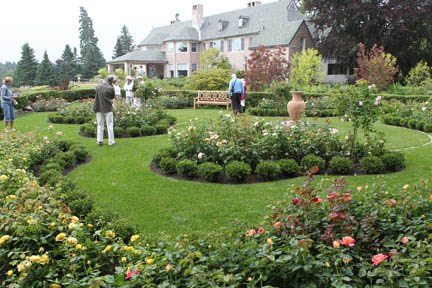
The most grandiose location was an estate called Kenarden  overlooking Frenchman's Bay.  It was built in 1830 by John Stewart Kennedy, a Scottish immigrant, who had amassed a fortune in Scotland's ironworks and American railroads.  In 1933 it was bought by the inventor of Campbell's condensed soup and today belongs to one of his grandsons.  A stream with multiple waterfalls ran parallel to the long entry road through mature forest. The estate included an Italian garden, rose garden, lily pond, and yacht landing, and multiple structures to service the main residence.  A large area near the entrance included greenhouses, cold frames, and gardens providing fresh vegetable, fruits, and cut flowers for the main residence.  The best thing about garden tours is that you see what others have done and get excited about incorporating the ideas into your own garden.


View from the front porch


Italian Garden


Back in Ellsworth , a visit to the Union River Lobster Pot rounded out the day.
Four Pounders!


Wednesday, June 30, 2010

In Search of Northern Michigan Warblers

June is the busy nesting month and I made several trips shooting at various locations beginning at the Jordan River Valley and ending at Whitefish point. The Jordan River Valley has been a favorite of mine for warblers.  I have seen hybrids of the Blue-wing Warbler and Golden-wing Warbler in this area for the last two years.

The Blue-winged Warbler on the left is more common in the southern third of the state while the Golden-winged Warbler  is more common in the north.  They commonly hybridize. The Blue-winged Warbler, however, seems to be moving into and replacing Golden-winged warblers in many parts of its range.  There are two well-known hybrids from these species (Brewster's and Lawrence's), but the hybrid below (a photograph I took last year) is neither of these.


It appears most similar to a Blue-winged but with golden wing patches and a partial black cheek patch.  This image was published in the January-March 2010 issue of "Michigan Birds and Natural History".  I observed a similar bird again this year but was not able to photograph it.

Another warbler found in the Jordan River Valley is the Canada Warbler.  I was alway intrigued by its "necklace".  Whenever I find this bird I know that I should drench myself in DEET since it always seems to be in wet, mosquito-filled areas.  I found several singing males with two of them being very cooperative.


Two more common warblers photographed here were the Blackburnian Warbler


 and the Black and White Warbler


Two relatively large warblers which like to stay out of sight in thick vegatation are the Mourning Warbler and Connecticut Warbler.  Both of these "skulkers" can be found in Michigan but the Mourning is much more common.  The Jordan River Valley has an abundance of these.


In contrast, the Connecticut Warbler (below) is quite difficult to locate although the Trout Lake area in the U.P. seems to be the most reliable place to see them.  Note the eye-ring which separates it from the similar Mourning Warbler


The Kirtland's Warbler has been one of Michigan's rarest birds.  The first census in 1952 counted only 432 singing males-all in the Lower Peninsula.  This total dropped to only 167 birds in 1987.  A concerted effort to aid this species has resulted in a steady climb with the results of the 2009 census producing 1826 total singing males with the appearance of a few males in the  U.P, Wisconsin, and Ontario.  Michigan can no longer claim that it is the only state in which this bird breeds. I photographed this singing male near Whitefish Point on June 15.