Thursday, January 16, 2014

From the Icebox to the Oven

After returning from Canada, weather reports were not encouraging for planned road trips to shoot eagles along the Mississippi River or a trip to northern Minnesota.  Wind chills close to 50 below at Duluth made the decision to head south easy.  Two days later I was in central Florida traveling down Joe Overstreet Road to Lake Kissimmee.  Highs in the mid eighties were predicted.

Joe Overstreet Road was made famous by a local photographer who guides here and wrote an e-book
on bird photography along the road.  It is not too difficult to see 50 species on the four mile ride to the boat launch and small fish camp on Lake Kissimmee.  Bald Eagles and Sandhill Cranes are a given and Whooping Cranes (from an attempt to establish a flock here) are often seen.  Locals (mostly cattle ranchers and sod farmers) are familiar with slow driving cars armed with camera lenses.  Keep in mind that blocking the semi trucks hauling sod will cause ill-will for later photographers enjoying the road.

On the drive to Lake Kissimmee it seemed every half mile contained an American Kestrel.  Loggerhead Shrikes were almost as common along with Savannah Sparrows.  Two Bald Eagles sat in a dead tree with a Crested Caracara 100 feet away.  Sandhill Cranes walked alongside the road rather unconcerned about my presence.  When I reached the boat launch I followed my usual custom of turning left through the camp and heading south to a mowed grassy area where airboats launch. 

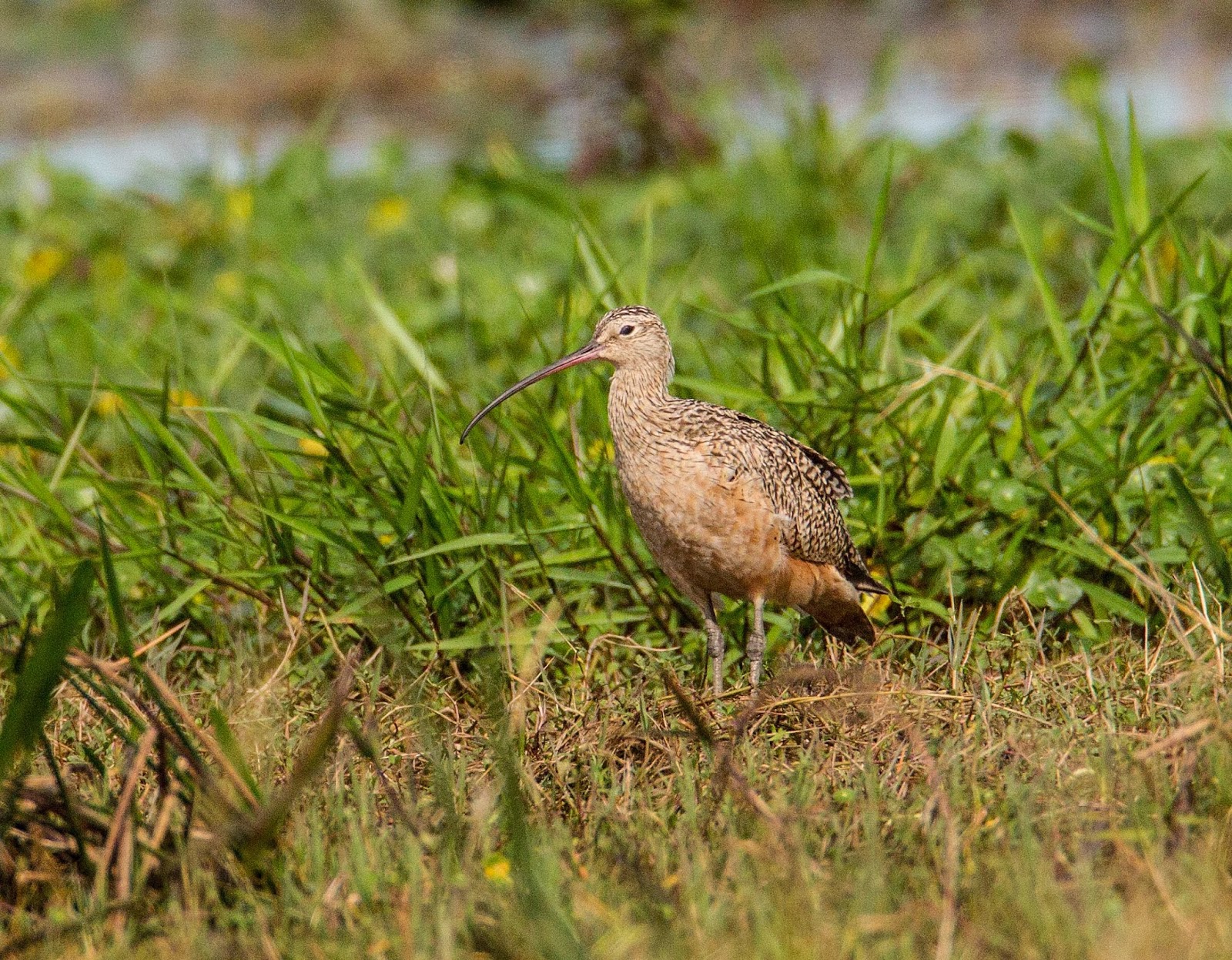
As I set up I could hear a Red-shouldered Hawk calling to my right, an Eastern Meadowlark behind me, and Boat-tailed Grackles and Red-winged Blackbirds to my left.  In front of me White and Glossy Ibis were working the weedy shoreline along with a Tri-colored Heron and Little Blue Heron.  A Wilson's Snipe flushed as I moved forward but Forster's Terns stayed on the fence posts that extended out into the water. American Coots and Common Gallinules were everywhere. A Long-billed Curlew foraged closer to the air boat launch. 

As I was watching the Curlew a female Snail Kite flew slowly over the boat launch and approached the area in front of me.  As I began to focus on the Kite, a Boat-tailed Grackle launched itself from the rushes and attacked the Snail Kite from beneath.  The Grackle would appear to be overmatched but the element of surprise along with the heft of this relatively large and heavy grackle seemed to have an effect on the Kite.  After the attack it immediately perched directly in front of  me and seemed unharmed but a little dazed.  Probably not a good experience for the Kite but a great one for the photographer.  Be prepared for great experiences when working Joe Overstreet Road.


Boat-tailed Grackles are large, noisy, and sometimes annoying but who would have
thought they were the gangsters of the marsh.


Pursuit of the unsuspecting female Snail Kite who is simply foraging
for snails


Sneak attack from below


I don't know much about Kite facial expressions but this female seemed
to have a "what just happened" look on her face.


A beautiful male Snail Kite arrived on the scene a little later.


Always expect Common Gallinules to be sounding and acting goofy.


Bald Eagles continue to fly by on their way to and from the lake.


Little Blue Heron


Eastern Meadowlark


Tri-color Heron


Long-billed Curlew

The sheer numbers of Turkey and Black Vultures in Florida in winter
makes me wonder how many dead critters this state produces.


The people and airboat activity at the launch produce very unconcerned
birds which make the photographers job easier.


A common sight along Joe Overstreet Road


Wednesday, January 15, 2014

Niagara Falls in Winter

The falls offer a different beauty in the winter
Niagara Falls in the winter is not for everybody.  Niagara Falls at six below zero appeals to even fewer individuals.  I had often read of the great variety and number of gulls found during the winter along the Niagara River. I decided to make a quick road trip there in the hopes that the severe weather we have been having lately might improve in a few days to make a trip to the Sax Zim bog in northern Minnesota possible .  A second incentive was a desire to improve my identification skills.  I have often thought that the more time spent trying to get the "perfect shot" of an individual bird (photographer mode) tends to limits the practice needed to gain field identification skills (birder mode).  I hope to turn the dial more toward the birder side this year.

Above the falls at six below

A total of 19 species of gulls have been recorded in the Niagara area with a record of 14 being seen in one day. That is apparently a world record.   Besides the usual Ring-billed Gulls and Herring Gulls, it is possible to see Bonaparte's, Little, California, Thayer's, Glaucous, Franklin's, Iceland, Large Black-backed Gull,  Lesser Black-backed Gull, Sabine's, Ross's Gull, Black-legged Kittiwake, Ivory, Slaty-backed, and Heerman's.  Since gulls can have a different plumages in each of their first 3 to four years of life and exhibit individual variability, identification can be very challenging and frustrating.

Expect to find warmly dressed tourists in the area

A third reason for going was to witness another one of nature's spectacles.  Every evening just before dark thousands of Bonaparte's Gulls, which have been feeding on the river, fly past Niagara on the Lake to roost on Lake Ontario at night.  This usually occurs through mid January.  Other species may join this group.  This spectacle has been named "The Niagara Fly Past".

The drive from Michigan was uneventful.  We checked into our hotel, bundled up, and joined the rest of the tourists.  My first impression was that Niagara Falls in the winter is not much different from Niagara Falls in the summer.  There are the same huge numbers of tourists, high prices, and a little tackiness which detracts from the beauty of the natural falls themselves.  Gaudy lighting on the streets and attractions are just the beginning.  Since parking is at a premium people stop their vehicles in the middle of the street so a passenger can jump out and take a picture while drivers behind then curse.  This may have been exacerbated by the cold.

My biggest disappointment, however, was seeing that the number of gulls was greatly diminished from what I had expected.  Both in the gorge and above the falls the numbers were down.  I counted only four species (Great Black-backed Gull, Glaucous Gull, Ring-billed Gull, Herring Gull).  I did not see a single Bonaparte's Gull.  I began to suspect that the extreme cold and icing had driven many of the gulls to the east coast and south already.

Notice the ice build up on the Mute Swan's bill

My fears were confirmed the next day as I checked along the river to Niagara on the Lake and found more of the same.  The river contained mostly Long-tailed Ducks and White-winged Scoters although there were a few Mute Swans, Canadian Geese, Canvasbacks, Redheads, and Buffleheads.  Just in case I had missed the gulls on the river somehow, I spent an hour before dark along the river to see the "Fly Past".  Very few gulls sailed by but hundreds of Long-tailed Ducks and White-winged Scoters gradually traveled to spend the night on Lake Ontario.  Edie wisely decided to skip the "Fly Past" and spent the time shopping in Niagara on the Lake.  We found the atmosphere here much more enjoyable than in the Niagara Falls area.  We ate at the Little Red Rooster restaurant before returning to our hotel. 

Long-tailed Ducks
Male and female White-winged Scoters

For anybody wanting to go winter "gulling" I would advise mid November thru December or at least during a normal temperature year if going in early January.

Sunday, October 6, 2013

Chincoteague National Wildlife Refuge

Chincoteague NWR was a pleasant surprise for me.  I had heard references to it many times, often with mention of the wild pony herd but it really was never on my radar.  When Bombay Hook became tough for bird photography I decided to head south for the afternoon and check it out.  The town looked like a place you could easily spend a week and never get tired of it.  The area has large areas of salt marsh, wide sandy beaches (very well used on warm weekends), dunes, and even some pine and oak at the southern end. Many brant, geese, and ducks winter there along with migrating shorebirds spring and fall.  I only had a few hours but it was enough to decide that on my next visit I would book a hotel here rather than near Bombay Hook.


Birders and photographers were excited by a continuing European Bar-tailed Godwit.


Snowy Egret Parade

Black Skimmer


Bombay Hook National Wildlife Refuge


This area was bought by the Dutch in 1679 from the Indians.  It was called "Boompies Hoock" or tree thicket in German.  The Price: One gun and some powder, three waist coats, alcohol, and a kettle.  At close to 16,000 acres it is now managed to support migrating ducks and geese.  I was early for the large numbers of these (over 100,000 Snow Geese will arrive here later) but hoped to find some shorebirds.  I did find them at Shearness Pool  (the largest of the four fresh water pools in the refuge) in good numbers. Most were American Avocets, Greater Yellowlegs, Semipalmated Sandpipers, Willets,  and  Least Sandpipers.  The only problem was distance.  I hoped that they might move closer at different times but they stayed well away from the road.  

Large numbers of Bobolinks and sparrows were feeding in the tall grasses along the roads but for most of the time being a birder rather than a photographer produced the most results.

Bobolink

Caspian Tern

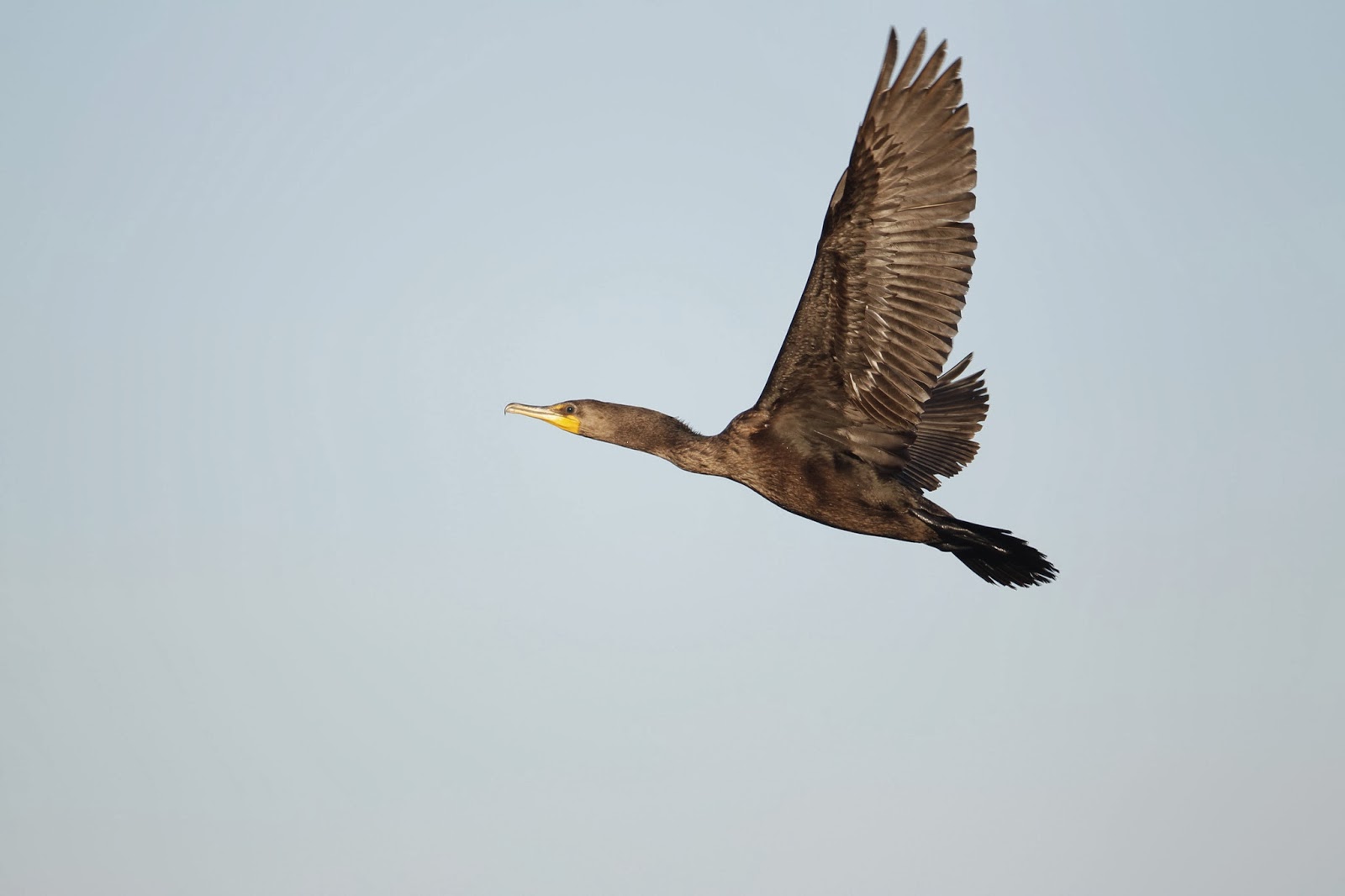
Double-crested Cormorant

Saturday, October 5, 2013

Michener's Chesapeake

Fans of James A. Michener understand that when they pick up one of his novels they are in for a long read.  The reward, however, is a deep understanding of the region he is writing about and a literary bonding with the inhabitants. Michener's novels are the closest thing to owning a time machine that one can experience. The political, economic, religious, geological, and biological forces that impacted the inhabitants are all understood as Michener introduces us to individuals and families that had to deal with these forces. He follows families as generation after generation struggle with the issues of their time. As individuals are born and die the reader becomes emotionally attached (for good or bad) to them. This is a goal of every novelist but Michener succeeds more often than not.

Chesapeake deals with the history of the Great Chesapeake Bay area, specifically a small area of Maryland's eastern shore where the Choptank River flows into the Chesapeake. Michhener begins in 1583 with a regal Susquehannock indian called Pentaquod. From there we are introduced to all manner of humankind that called the Eastern Shore their home. The Steed, Turlock, Paxmore, and Cater families become unforgettable. After I had read the novel for the first time I decided I had to visit this area. I primarily wanted to "scratch the Michener itch" but also to visit and photograph some of the wildlife areas if possible.


After a long drive from Michigan we arrived in Oxford, Maryland to stay for two nights at the Robert Morris Inn (www.robertmorrisinn.com). This inn was built in 1710 by ship carpenters and still has wooden pegged paneling in the main dining room. Robert Morris was a wealthy ship builder who helped finance the American Revolution and was visited many times by his friend George Washington. James Michener chose this inn to write the outline for his book and ate many of his meals here. That alone was enough reason to book one of their rooms.


When you stay at a 300 year old colonial inn you must be prepared to be a little flexible if your only comparison point is the Hyatt Regency. The weather was unseasonably hot and central air is only a dream at this point. The upstairs hallway leading to our room was approaching 100 but two window air conditioners worked on max to keep the room comfortable. I do not believe there is a level floor any where. If a marble was placed in the center of our room it would rapidly hit the side wall with a clunk. The emergency lighting was a labeled flashlight next to the bed. Bottom line: staying here is a little adventure mixed with a wonderful experience.


British born Mark Salter is the chef/proprietor of the Inn. After settling in we found we could dine either in the less formal, slate floored Tavern and Taproom or the formal chandeliered dining room. We chose the dining room. I ordered the seafood platter while Edie had the crabcakes. Although the portions were on the small side they were excellent.


In Chesapeake, the village of Patamoke plays a central role. Patamoke does not really exist but is a composite of several area towns that Michener researched. Oxford, where we stayed, along with Easton, St. Michaels, and Tilghman Island all contributed. Wanting to experience all of these places we ate an early breakfast at the inn and took the Oxford-Bellevue ferry (established 1683) across the Tred Anon River which is a contributary of the Choptank River. The ferry is right next to the inn and the ten minute ride costs $12. While conversing with the deck hand I found out that his mother ran the post office in St. Michaels where Michener picked up his mail. She has an autographed copy of Chesapeake.
The Skipjack Rosie Parks slated for completion this year

The working boatyard

An  illegal duck gun could kill dozens with one shot.  You would point the boat rather than the gun

Michener actually wrote his novel while living in St. Michaels and that was our first destination. After exploring the town we purchased tickets for the Chesapeake Bay Maritime Museum (www.cbmm.org). The $13 ($10 for seniors) admission was worth every penny. The life of the bay area and Michener's stories came to life here. The log canoes, skipjacks, and exhibits such as "Oystering on the Chesapeake" and waterfowling methods (both legal and illegal) brought the bay history and Michener's stories to life.
Leaving St Michaels aboard the Patriot

Docked next to the Museum is The Patriot, a 149 passenger cruise ship which gives a narrated tour (www.patriotcruises.com) down the Miles River.


We continued our tour by driving to Easton. Michener's original manuscript is kept at the library there but is not on public display. There is, however, the Third Haven Meeting House which Michener mentioned in his book. Quakers played an important role in the history of the area and the imaginary Paxmore family was one of the most influential. The original building (now known as the meeting house) was built in 1682 and is the oldest religious structure in the United States and the earliest dated building in Maryland. It is very simple both inside and out as one would expect and sits wide open to the public.


Thursday, October 27, 2011

Cherohala Skyway and The Dragon's Tail

The Cherohala Skyway is a National Scenic Byway stretching 43 miles through the southern Appalachian Mountains between Tellico Plains, Tennessee and Robbinsville, North Carolina.  While rather desolate in the winter, the road becomes busy in the fall as 120 species of trees, sweeping vistas, and changes in altitude give the visitor a glorious display of color over a very long foliage season.  During the last week of October we found bare trees above 3000 feet but peak color in the lower altitudes.  Tellico Plains, Tennessee is on the western end of the road, and being at lower altitude was the perfect home base for us at this time of year (There are no facilities on the highway so staying at one end or the other is necessary).  
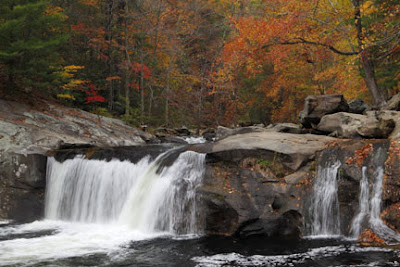
Bald River Falls

Along the Cherohala

Bald River Gorge

This area adjoins Smoky Mountain National Park, by far the most visited National Park in the country.  Because of this popularity photographers often find themselves in traffic jams and fighting each other for some of the more photogenic (and overshot) areas.  The Cherohala Skyway area has many of the same opportunities but far fewer visitors.  I did not see another tripod until the third day.
That does not mean, however, that you have the area completely to yourself.  Sports car enthusiast and cyclists find the roads in the area very attractive and businesses cater to them.  The most famous of these roads is The Dragon's Tail (http://www.tailofthedragon.com/ ) which boasts 318 curves in 11 miles.  Traveling this paved road would not be the best choice for somebody susceptible to car sickness but for the lover of sports cars and fast cycles it is pure adrenaline.  Several online photographers set up along the road and snap your picture as you cruise by.  In a couple days you can find and order your picture.  Since The Dragon's Tail is part of State Highway 129 the fast machines have to share the road and you may find your beat up Silverado being tailgated by a Ferrari or Viper.  Sometimes tractor trailers use the road which can be dangerous since they have to use both lanes to navigate many of the curves.  Meeting one of these on a cycle as they block the entire road is a cyclist's nightmare and hence the name "cycle eater".


Arriving back in Tellico Springs your choices at fine dining are somewhat limited but the Tellico Grains Bakery ( http://tellico-grains-bakery.com/ ) is a wonderful place for lunch if you can find a parking spot between the Corvettes and Vipers.

Coker Creek Falls

Baby Falls

Wednesday, October 12, 2011

Chasing color in Michigan's Upper Peninsula

Michigan's Upper Peninsula is a wonderful blend of national forests, waterfalls, casinos, smoked fish, pasties, and inhabitants who call themselves "yoopers".  Any time of the year can be interesting in the U.P. including the long and hard winters.  Toughened birders search out boreal species which often spend January and February in this area.  I can remember photographing Great Gray Owls on Sugar Island when the early morning temperature had dropped to 18 degrees below zero.  Spring time is exciting as the forests in the area become home to many species of nesting songbirds.  My favorite time there, however, has little to do with birds.
The first week of October brings one of nature's greatest shows to anyone willing to make the drive.  The diversity of tree species that this area produces brings an unbelievable fall color spectacle that rivals anywhere on earth including New England.  Web sites such as http://www.foliagenetwork.com/ give a general idea of how the color is progressing.  Generally, color starts in the western portions of the U.P. and move east.  The change is not uniform and I have noticed that areas close to water sometimes are a few days later than more interior regions but no two years are the same.  A lack of moisture or variations in temperature all effect the results. 
This year I spent time from Brimley in the east to Copper Harbor in the west.  One of my favorite and most consistant areas is located around Munising.  Highway 58 is one of the best and most popular paved roads in the area for "leaf peepers".  Unfortunately this year some one has been dumping nails on the highway and a large number of motorists have reported flats.  News reports say the police are looking for the individual and do not think it is accidental.  My solution is to get off the highways since the national forest roads provide a much deeper color experience.  They are dirt, fair weather roads, but passable in any car in the fall, unless there has been a lot of rain.  Bring a good map and gps and be prepared to be amazed as the colorful canopy at times completely covers the road and surrounds you in color.  You will never experience this on the highway and you can slow way down without being tailgated and usually will meet only a few other cars.  For starters, I would suggest leaving Highway 58 (paved) at Melstrand and traveling Highway 52  (dirt) southwest to Highway 28 which is the main road in the area and will take you back to Munising.  This is only one of hundreds of forest roads in the area that would produce similar results.  After a full day of touring a meal at the "Dogpatch" ( http://www.dogpatchrestaurant.com/) in the middle of town is a local favorite that always satisfies.  If you are feeling like a steak you can grill your own at "Foggys Steakhouse and Lounge" in Christmas just west of Munising.  Foggy's open pit barbecue is only fired up on Friday's and Saturdays and that is the only time I would recommend eating there.  During the week you would do better to travel down the road to the Brownstone Inn.