Friday, March 25, 2011

Wakodahatchee and Green Cay Wetlands, Florida

Separated by only a couple miles, both of these wetland areas share a lot in common.  Both are run by the Palm Beach County Water Utilities Department Southern Region Water Reclamation Facility.  Both cleanse several million gallons of highly treated water daily, are located in the middle of suburban areas-Wakodahatchee in Delray Beach and Green Cay in Boynton Beach, and serve as a recreational park like setting for thousands of local Floridians and visitors.  The large parking lot at Green Cay can be overflowing on any given morning with school groups, walkers, birders, and photographers while the smaller parking area at Wakodahatchee demands an early arrival.
Green Cay's Visitor Center

Green Cay is the newest facility and boasts a 9,000 square foot visitor's center and 1.5 miles of boardwalk.  It was originally open prairie with wetlands.  The site was then converted to farmland for many years until the owners donated it with the intentions of restoring it to an everglade-like wetlands ecosytem.  Wakodahatchee is the older site and was vacant utility land that was transformed in the same manner.  It is a smaller site with only half the boardwalk but boasts 140 species bird list.

I visited these sites two mornings and one evening and found that there was more photographic opportunities, at least for this time of year, at Wakodatchee.  Wakodatchee has several small islands placed close to the boardwalk that was attracting a fair amount of nesting activity from Great Blue Herons, Great Egrets, Cattle Egrets, Tricolored Herons, Green Herons, Anhingas, and Ibis.  Some species were far along in their nesting cycle with large young in the nests, while others were busy carrying sticks.  Green Cay has much larger expanses and does not offer these nesting islands but on any given day can be very good for photography.

Tricolored Heron heading out again after delivering a stick to it's mate


Great Egret


Great Egret landing at nest
                             
                       Two Green Herons were beginning to build a nest while a third individual apparently watched as the "odd man out"


An either "happy" or "upset" Black-crowned Night Heron.  Sometimes it is hard to tell!


Glossy Ibis


Great Blue Heron


Cattle Egret in stick-carrying ballet
I was hoping to photograph both American Bitterns and Least Bitterns but did not get a chance.  I saw American Bitterns at both sites but could not get clear shots.  Least Bitterns were apparently hiding.

Not all the activity was confined to the islands as the pools also attracted species such as Black-necked Stilts.
Black-necked Stilt

Friday, March 4, 2011

Birding while Cruising


I have read accounts of birders who do a lot of birding while on cruises.  They are the first ones off the boat at each stop and try to hit the most likely locations in their alloted time.  This is a great way to lengthen a life list.  For the bird photographer, however, I found it less than ideal.  Without a previous scouting of the area to know where the birds are and how they behave in their local environment,  great images are difficult to obtain.   Although the digital results are often disappointing, it still is exciting since many of the birds seen are new. 
A short cruise to CocoCay and later to Nassau in the Bahamas allowed me to try for a few new species.  Ideally, I would have liked to disembark before sunrise but that is impossible.  By the time you set foot on land you have already missed an hour of the best light with only a couple to go.  Finding a subject before the sun gets too high is a matter of luck in the the remaining time.  
The best stop for avian photography was CocoCay.  After I got off the tender boat I turned to the right and started down the island.  Almost everybody else turned left and headed for the main beach area.  The shoreline was rather windy so I moved into the scrub and more forested areas.  There was a labelled nature trail that produced the most activity. 
Bananaquit
Black-faced Grassquit

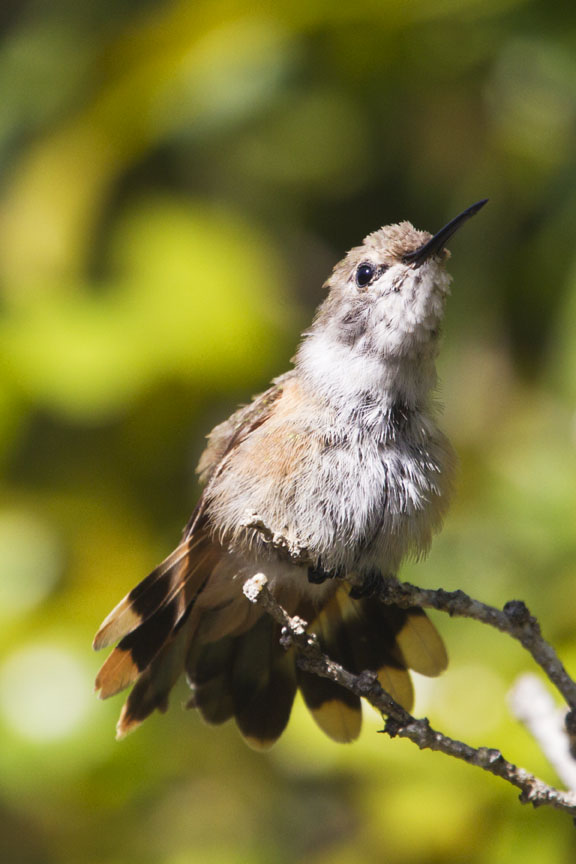
Bahama Woodstar Hummingbird

Not all birds encountered, however, are new species.  I was hoping for a Bahama Mockingbird but instead got  a large number of Northern Mockingbirds.

Common Ground Doves were very common everywhere I went.

About ten o'clock the main horde arrived.  After the 5th vactioneer tapped me on the back and asked me what I was photographing I decided it was time to quit. 
Nassau produced very few bird images.  Having been warned not to stray too far with photographic equipment I spent the day as a typical tourist.  We hired a tour guide, Rev. Anthony, who came from a family of 10 children, grew up in the hood, but through perseverance got an education, and now preaches at  his own church, and hustles tours on the side.  According to him he has lost a considerable amount of weight recently through a healthy diet consisting entirely of nuts.  As evidence of this he munched from several bags of nuts the entire trip.  According to the Reverend there is no middle class here.  They are either very rich or very poor.  This seemed to be supported by the places visited.  On the drive through the hood we saw the poverty side.
The contrast could not be greater when viewing the Atlantis complex where the daily rate on some rooms could buy one a brand new car.
Shooting from the boat was an exercise in futility as very few birds were seen at sea.  The only wildlife on board seemed to be the the deck parties.  Not exactly what I had in mind but interesting nevertheless.


Tuesday, February 15, 2011

Cypress Lake Fish Camp...Going...Going...Gone!

Florida fishing camps are ubiquitous throughout the state.  Many started out years ago as a deep hole at the end of a bumpy dirt road where airboaters and fishermen would launch their rigs.  As time marched on a natural evolution followed which included adding a few hunting/fishing shacks on stilts.  Alligators would often float up to the structures if the squatters living there tossed out the remains of their hunting and fishing trips.  Wild hogs were common and birds were heard throughout the day and night.  Eventually cattle replaced many of the hogs.  A small business would start up.  Ramp fees, a small store, and maybe a little restaurant would allow an owner to make a modest living.  Cabins, and maybe an rv park would soon provide all the ingredients for a great place to fish, hunt, relax, or in my case, to photograph wildlife.
Northern Parula found in cypress swamp south of fishing camp


Limpkin hunting snails along channel


Pileated Woodpecker photographed near boat ramp

Cypress Lake Fish Camp and RV Resort was a great example of a Florida fishing camp.  The roar of airboats, constant parade of fishing boats, and in the winter snowbirds in their RV's created a friendly mix of inhabitants. Wildlife coexisted nicely alongside their human counterparts.  Large alligators were often seen as one motored down the main channel to the lake.  An unafraid barred owl often flew from one favorite perch to another and hooted over the RV's.  Throw in nesting Sandhill Cranes, noisy Red-shouldered Hawks, Limpkins feeding on snails by the boat docks, and vultures roosting in the cypress swamp south of the R.V.s and you felt you were living in "Old Florida".  Photography was magnificent.  Warblers, vireos, and woodpeckers were numerous in the cypress swamp while wading birds dominated the grassy area between the lake and camp.
Glossy Ibis photographed in front of fish camp

Sandhill Crane nest photographed in front of fish camp

Red-shouldered Hawk

Progress marches on, however, and several months ago the camp was sold.  The snowbirds were told they must all be out by May-never to return.  The squatters to the north of the boat ramp will leave and their shacks will be destroyed.  The quaint former restaurant will now sell novelties such as dried alligator heads to tourist who have come to see "Wild Florida".  Latest rumors have 150 live alligators being added to the pond which now is shielded from non-paying eyes on the road side by a newly constructed fence.  A parrot cage already contains inhabitants and a boardwalk/nature walk will travel through the cypress swamp to the south.  You will need a ticket to see this new "Wild Florida". 

I will miss this example of old Florida.  Hopefully I can find another fish camp somewhere down another road.

Saturday, January 29, 2011

Fort DeSoto, Florida

Fort DeSoto is a Pinellas County park located just south of St. Petersburg.  With 1,136 acres, 7 miles of waterfront, 2 fishing piers, and being named as America's top beach, it is easy to see why it has 2.7 million visitors per year.  It is also a well known location for nature photographers.

A typical day started with a pre-dawn trip to East Beach where on a calm day with low tide there are multiple opportunities for silhouette photography with the Sunshine Skyway Bridge in the background.

After the color has burned out at East Beach a drive to North Beach usually produces great opportunities for everything from small shorebirds to large waders.  This year, however, the birds seem to have abandoned the lagoon, at least for this month.  A few egrets, and often single representatives from members of the heron clan was the usual fare.  The paucity of birds made wading after them seem rather futile.  One exception was a "feeding frenzy" that occurred on a cold windy morning at the Arrowhead Picnic area.  Dolphins and White Pelicans had herded baitfish into the inlet there which provided breakfast for about 50 White Pelicans, along with about the same number of Great Egrets, Snowy Egrets, and Little Blue Herons.  

A dozen Great Blue Herons also joined in the spectacle and seemed to be the only species which could not get along with their own species.  Fights were constantly breaking out whenever two or three got too close to each other.


Just north of Fort DeSoto on the west side of Highway 679 several fresh water ponds held hundreds of Redheads, Northern Shovellers, Ring-necked Ducks, Scaup, Coots, and Pied-billed Grebes.  On the west side of the smaller pond a pair of Bald Eagles have built a nest.

 A park ranger stopped to chat on the first day I set up to photograph the nesting activities and told me it was a young pair with at least one chick which hatched about two weeks earlier.  The nest had failed the previous year and a male was reported to have been killed by another male but he could not confirm that.  This year the pair seemed to be doing a good job and hopes are high for a successful brood.  I photographed them on several mornings and watched as the male continued to bring in fish and occassionally branches and nesting material.  On one return trip he stopped short in a nearby pine tree and begin to pluck feathers from his prey.  After he had removed most of the feathers he carried it the rest of the way to the nest.  He presented a rather gruesome sight with his bloodied beak and what appeared to be a hapless coot with its dangling feet trailing behind. 


There are many other opportunities here for photography.  Osprey, for example, are nesting everywhere.  At times they almost seem to be colonial nesters as they are tolerating nests closer than I would have ever expected.  Around the campground many of the birds are ridiculously tame.  They have been habituated to the campers and at times will practically walk over your feet when sitting at the beach.  The picture below shows that they are unfortunately being fed by some campers.  Edie did not have any food in her hand and was not feeding them (Edie is smart enough not to be holding anything edible with that lightning fast sharp beak close enough for a strike)


When looking for a restaurant in this area the only problem is choosing from the especially large and varied list.   The store manager at the campground recommended Billy's located just north of the Park.  He said he has only received one complaint in all of the years that he has been recommending them.  Unfortunately, after eating there, he now has two.  Edie and I both ordered the Grouper.  I had mine blackened while Edie opted for the fried.  Mine was ok but Edie's was very dry and over fried.  After leaving she kicked herself for not sending it back.  I only reinforced her mood when I told her that after the waiter had asked if I wanted bleu cheese crumbles on my house salad ( I,of course, said yes) they had charged me extra for it.  Lesson learned.  Ask questions and deal with problems immediately.

The stretch from St Petersburg Beach to Pass-a-Grille Beach is especially rich in restaurants.  The Don Cesar is a famous landmark containing a very upscale restaurant.  After reading some very scary reviews (food poisoning to bad service) we decided to skip it and go casual.  After several recommedations we decided on the Sloppy Pelican (http://www.sloppypelican.com/) which turned out to be a rather typical two story beach dive but as Edie said, "It restored her faith in restaurants".  With a great menu and cheap beer it definitely fulfilled its slogan of "Good Food-Good Times".  Edie had their fish tacos while I had the Seafood Marinara Skillet.  Both were excellent


In Pass-a-Grille Beach we have tried the Wharf Seafood Restaurant and the Sea Horse Restaurant.  Both were good.  Sea Critters Cafe (near the Wharf) has gotten good reviews but we have not eaten there yet

Wednesday, November 17, 2010

Kudos and my new web site

Returning from Arizona we stopped at Branson to see a couple shows where I was informed that the Trumpeter Swan Society had picked one of my photos for their November photo of the month.  It can be seen at http://www.trumpeterswansociety.wordpress.com/.

In addition, my old website, vanormanphoto, has been defunct for some time but I have finally got the new one, http://www.vanormanphotography.photoshelter.com/ ready.  It allows me to put up a lot more images and sell directly from the site.

Monday, November 15, 2010

Grandchildren Quiz

We left Alamogordo Monday morning and stopped for the night in the tiny town of Shamrock, Texas.  A vaguely familiar building was lit up down the street from Big Vern's Steakhouse where we ate.  This iconic Route 66 building was featured in a movie that Mack, Ryan, Grace, Leah, Laura, and Marley have seen many times.  Do you know the movie that used this building???

Alamogordo, New Mexico

Black and White
Alamogordo is not on the beaten path but it does have some unique attractions. The best known is White Sands National Monument.  Surrounded by the White Sands Missile Range and associated with Holloman Air Force Base it is not unusual to have the Air Force close the monument to visitors or even stop traffic for an hour on Highway 70. 
Michigan residents will feel right at home when visiting White Sands.  The dune formations are very similar in appearance to Lake Michigan dunes. There are differences, however.  The sand is gypsum based, very fine, and very white.  So white in fact that one can easily imagine being in a winter wonderland-especially when hundreds of locals bring their kids to sled down the dunes on Saturday afternoons.


The most prized photographs are taken only after hiking a long ways in order to avoid areas that have heavy footprint traffic.  A little caution is in order when hiking into the monument.  Bring water and keep track of landmarks since it is easy to get turned around in this area.  


While white is the dominant color at White Sands, black dominates the landscape at Three Rivers Valley of Fire north of Alamogordo.  When first driving through the area one speculates as to how surface fires could have blackened all the topography but soon realize that this is volcanic activity with lava being pushed through cracks in the earth which then flowed out over the land.  Many organisms here are quite dark while the same types are very light colored at White Sands.  Black lizards on white sand or white lizards on black rock don't last long when predators are about.


Petroglyphs and Pistachios


As we approached Alamogordo a huge pistachio statue loomed next to what looked like a typical tourist trap store (http://www.pistachiotreeranch.com/).  Knowing nothing about pistachios but intrigued by the orchard-like grove of pistachio trees growing next to a well kept vinyard and all in a desert environment- I slammed on the brakes.  Inside we found not only a tasting table for pistachios (lemon-lime was my favorite while cayenne flavored should be avoided) but also a well-stocked wine-tasting table.  Their pistachio wine, to our palates, did not have any hint of pistachio.  We walked out with an apricot, pomegranite, and a peach wine, along with a bag of pistachios and candied pecans.  Later that evening I decided that a few pistachios would make a nice snack.  They are something like potatoe chips and before I realized it I had eaten the entire bag.  Upon examing the label I found I had consumed 1360 calories.  Oh well-the label also said no cholesterol in pistachios.  I hope Edie does better with her candied pecans. 

On our final day in Alamogordo we drove up to the Inn of the Mountain Gods Resort and Casino for a Sunday champagne brunch at the Gathering of the Nations Buffet (http://www.innofthemountaingods.com/).  With a huge selection of food, seniors can gorge themselves for $12.95.  Afterwards, we waddled out of the restaurant deciding some exercise was necessary.  Edie wanted to see the Indian petroglyphs at Three Rivers which would require some hiking to view.  Over 21,000 have been found in this area.  Although the trail was very rocky for anyone who had fractured their patella recently, the hike was a welcome bit of exercise.