Friday, November 12, 2010

Manny's Buckhorn Tavern - San Antonio, New Mexico

New Mexico Green Chili Cheeseburgers - just the name hints that you are in for a little more heat than the bland Eastern Cheeseburger promises.  The small town of San Antonio, New Mexico seems to be the center of New Mexico's quest for cheeseburger perfection.  Two restaurants, so close they could throw rocks at each other, compete for the title of best cheeseburger served.  Gil Garduno's blog (www.nmgastronome.com/blog/?p=164) gives a great view of the competition.  Edie and I had eaten cheeseburgers at the Owl Bar in January and decided to try the Buckhorn Tavern this time.  There was a line waiting when we arrived at 2 in the afternoon but we soon found a seat at the bar.  It took a while to receive our order but we were warned by the sign which informed us that "if you were in a hurry this was not a fast-food restaurant".  At the bar we could watch the burgers being fried and check the potatoes being fresh cut for our french fry order. 

Both restaurants serve excellent green chili cheeseburgers.  The Owl Tavern burger was rated as one of the top ten burgers in America in 2003.  In 2005 GQ magazine rated Manny's as the 7th best burger in the country.  The latest accolades arrived when Bobby Flay from the Food Channel arrived for a culinary "Throwdown".  Manny's came out on top and Governor Bill Richardson declared Friday July 24 as "Buckhorn Tavern Day".  Edie and I both agreed that the Buckhorn's burger was bigger, better, and tastier than what we remembered having at the Owl Tavern. 

Thursday, November 11, 2010

Mt. Lemmon

On our last weekend in Tucson we decided to visit the Arizona-Sonora Desert Museum again followed by a drive up Mt. Lemmon.  The museum has one aviary with local birds and a second with just hummingbirds.  Both seemed somewhat devoid of birds compared to what I had remembered on previous visits.  A consolation prize, however, was a show stealing performance by a young Great Horned Owl at the raptor flights.  With a lot of head-bobbing, hooting, and dancing on branches he had the entire crowd laughing and showed why most people are fascinated by owls. 


The trip up Mt. Lemmon is a spectacular drive through hairpin turns, rock formations, and views of the desert below.  The climb starts at 3,000 feet and ends at 9,000 feet near the small resort community of Summerhaven and Ski Valley.  The cactus to conifers trip is the equivalent of driving from Mexico to Canada.  The bird life changes as altitude increases.  At the Molino Canyon Vista Point I found Black-chinned Sparrows-a lifer for me.  At the Molino Basin campground I was hoping to find Crissal Thrashers but drew a blank.  A rather tame tree-climbing Greater Roadrunner, however, was quite curious about me.


As I was packing up, the camp host drove up on a golf cart and informed me that you can't enter the campground without a $10 fee (on top of the fee you pay to stop anywhere on the route).  He was very nice about it and let me skate when I played the Michigan Ignorance card.   He said he was also a birder and known all over the country as the "Vagabond Birder". 
At the top I photographed Yellow-eyed Juncos which was another lifer for me.  The Junco is quite common on this "Sky Island".


Our plan was to eat at the Iron Door Restaurant and then drive down the mountain to a previously planned  vista for sunset pictures.  At 4:10 we entered the restaurant and were informed that the kitchen was closed.  So much for a great meal with spectacular views.  Our backup plan was pizza in Summer Haven at the only other restaurant around for miles. The pizza was ok but not great as was the sunset which featured a very uninteresting sky.

Wednesday, November 10, 2010

The Pond at Elephant Head

South of Tucson, a large monolith resembling an elephant from certain angles protrudes from the Santa Rita Mountains.  Near this monolith a small ranch owned by a man named Bill Forbes has become a pilgrimage for bird photographers.  Bill is a constant tinkerer and also inventor of the Phototrap, a triggering device for cameras.  Most photographers visit Bill to spend a day sitting in a blind near a small pond that Bill has dug.  Movable blinds and assorted perches provide artistic opportunities. 
November is one of the poorer months for species variety but since I had a three day weekend from my volunteering duties I spent Friday morning at Bill's.  I arrived an hour before sunrise and birds were already moving around the pond.  At 7:30  light hit the setups and birds began increasing in numbers.  Many of the birds were sparrows and doves but Gambel's Quail, Gila Woodpeckers, Pyrrhuloxia, and Cactus Wrens made their appearances.   

Black-throated Sparrow
Gila Woodpecker

Cactus Wren

Gambel's Quail


Curve-billed Thrasher

Tuesday, November 9, 2010

Wycliffe Bible Translators

Wycliffe Bible Translators is an organization dedicated to translating the Bible into every language and dialect on earth.  They are presently working in over 50 countries.  They have an extensive volunteer system which allows individuals to further this effort by undertaking tasks and performing work which would otherwise hinder and slow down the work of the translators.
Edie and I volunteered a couple of weeks at an associated organization called the Summer Instititute of Linguistics (S.I.L) headquartered in Catalina, Arizona.  Most of the Institute's work deals with Mexico.  Our first task was to "mud" a new fitness room to serve the several hundred volunteers and translators on site.  A local Curves had closed and donated all their equipment.  Our second project was painting a house owned by a translator who had just returned from Mexico.  This translator has worked on the Mixtec language in Oaxaca, Mexico for the last 15 years and should be finished in 2012.  A third project dealt with preparing a house for an arriving volunteer family.
Our stay here was a learning experience especially since we arrived with very little information.  Our first surprize was our accomodations.  Expecting anything we were given keys to a posada which turned out to be a very comfortable 2 bedroom apartment.  This was partly due to the absence of the multitude of volunteers who began arriving in late Novemberr and peaks in January and February.  The second surprize was the variety of ways volunteers serve and what they accomplish.  New houses are built, vehicles are repaired,  furniture refinished,  and data entered. 

Our Posada


View of the Santa Cantalina Mountains from the back of the posada

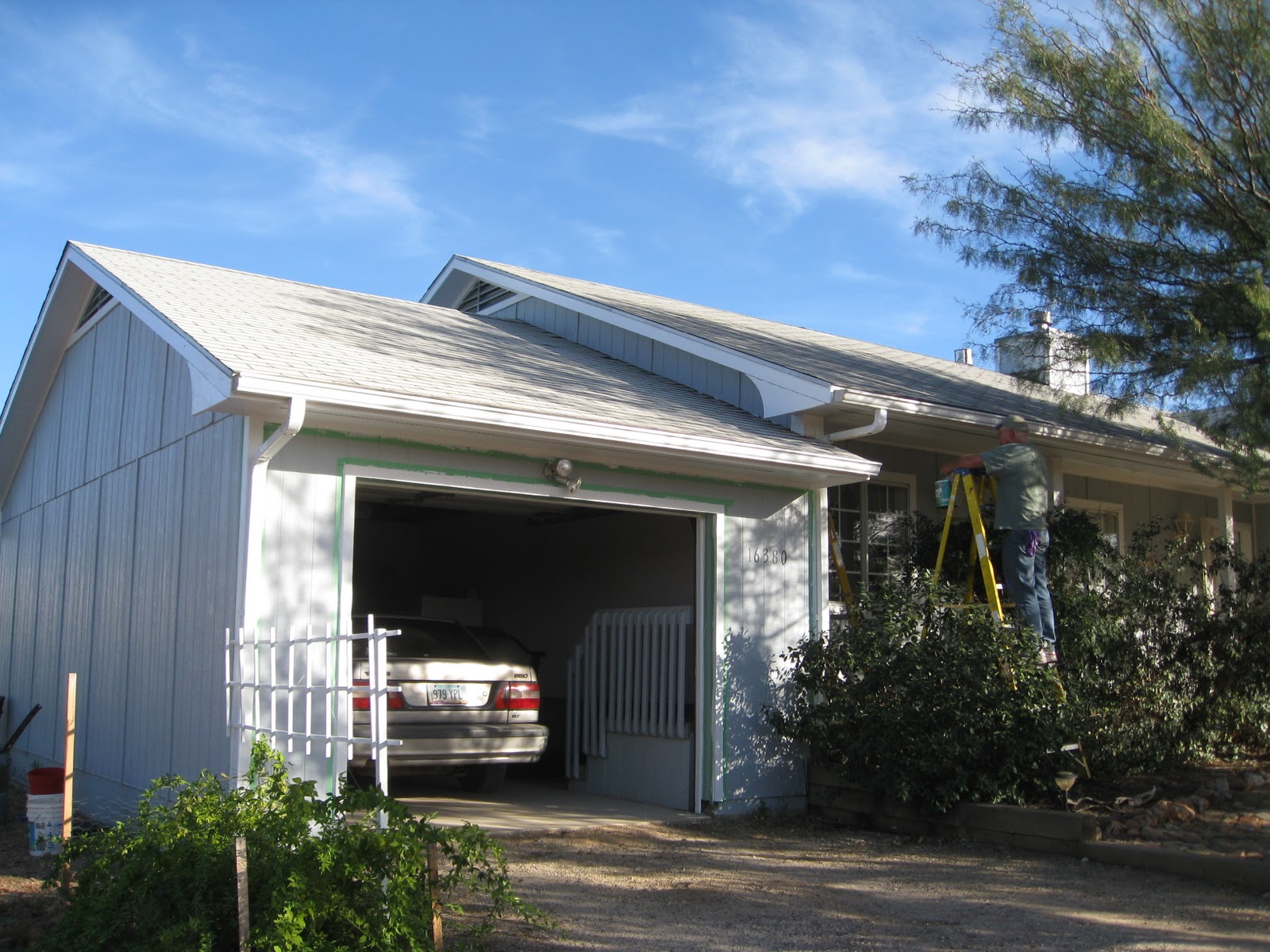
Working on one of the translator's  houses

Friday, October 29, 2010

Man vs Food in Tucson

We arrived in Tucson and immediately reviewed the local exploits of my culinary hero, Adam Richman. The twelve  patty OMG burger at Lindy's seemed over the top but the President's Platter at Mi Nidito Cafe ( http://www.minidito.net/) seemed just right.  Created for a vist by former President Clinton, it includes a chile relleno, enchilada, tamale, tostada and a taco.  I finished it easily but knew that it was a non-challenge event for Adam.        . 

The next morning we revisited the Sonoran Desert Museum (http://www.desertmuseum.org/) which runs a beautiful program that does a great job of educating visitors about the Sonoran Desert.  The only downside is that it opens its doors at 8:30 am.  The lighting at this time is very harsh for photography.  This is frustrating but nevertheless the raptor flight is an excellent presentation by the museum which features free flying raptors which fly over the crowds looking for portions of raw meat placed around the area by assisitants.   The program is very popular and never fails to please the large crowds which attend.  They hold two programs- one at 10 and one at 2.  Unfortunately the harsh lighting and the leg strappings on the captive raptors make the photographs somewhat unattractive  for most uses.  

After the raptor program the heat began to become oppressive.  Our Michigan weather had not prepared us for the record setting 94 degree heat which assaulted us in the afternoon.  We decided to  stop at El Guero Canelo (http://www.elguerocanelo.com/)  for the second Man vs Food  feature- the Sonoran Hot Dog.    This has been described as a chili dog on steroids.  A hot dog wrapped in bacon is placed in a bolillo roll.  Mayo, mustard, ketchup is added along with pinto beans, cheese, chopped tomatoes, chopped onions, and sliced jalapenos. There is no better hot dog!

Bosque del Apache, New Mexico

Having completed the amaranth havest in Michigan, Edie and I headed for New Mexico and Arizona.  Our primary mission consisted of some volunteer work for Wycliff Bible Translators based  north of Tucson,  but also hoping to do some photography.  We spent the first night in Tulsa, Okalahoma.  The second travel day found us bucking the strongest headwings I have ever experienced while traveling by auto.  Winds were averaging 40-50 mph with gusts recorded over 90.  Edie likened it to traveling by aircraft in heavy turbulence.  We arrived in Socorro, New Mexico in time for the evening meal.  We checked into our hotel and headed for The Stage Door Grill, only to find that it had closed.  Our second choice was the Socorro Springs Brewery Company (http://www.socorrosprings.com/), which unlike a lot of Socorro restaurants boasts a 11 year record.  Edie ordered the creamy pesto pasta with grilled salmon while I had the grilled red pepper salmon.  Both were excellent.  Since the brewery featured a beer which was described as having authentic Dutch origins (Heynankamp Dutch Lager)  we ordered their sampler of 5 beers which they had on tap.  I might be biased but I think the Heynankamp held it own among the other beers although I never did find out how the Dutch influence migrated to this area of the world. 
The following morning I arrived at Bosque an hour before sunrise.  Bosque is primarily a winter destination for birders and very few Sandhill Cranes and even fewer Snow Geese had arrived yet. I took a few pre-dawn shots and headed for the Wigeon pond on the campus of New Mexico Tech.  The pond here offers some of the most cooperative ducks anywhere.  Since it borders a gulf course the ducks are  use to heavy traffic and allow close proximity. 
Bosque Sunrise

Male Wigeon


Female Wigeon wingflap


Male Wigeon

Tuesday, October 12, 2010

Amaranth Project

American Goldfinch feeding on amaranth seed heads

Early this spring I volunteered to grow a half acre of amaranth for the Christian Reformed World Relief Committee (http://www.crwrc.org/).  Although the project was definitely not a roadtrip it did take precedence and altered my travel plans as I adjusted to a farming schedule. 


Amaranth Seedling

Amaranth is an ancient crop which was widely grown by the Aztecs in the 1400's but soon was forgotten and only grown in limited amounts at scattered locations.  Research starting in the 1970's rekindled an interest in the crop when its hardiness and useful nutritional qualities were rediscovered.  High protein levels along with the amino acid lysine made it a healthy addition to the deficient diets commonly found in poorer nations.  Because of this the CRWRC has worked hard to introduce this plant and educate people in Africa, Mexico, and Asia. 
The plant turned out to be extremely hardy once it sprouts.  It tolerates high temperatures and requires much less water than corn and other widely grown plants.  In Kenya the seedheads are white or yellow but the American variety is a beautiful bright red which, as it matured, attracted passerbys who would slowly drive down our driveway trying to figure out what kind of crop we were growing.


On October 10 the crop was harvested.  Approximately 100 people from Fairway Christian Reformed Church of Jenison, Servant's Church in Grand Rapids, representatives from CRWRC, and the VanOrman clan experienced a typical African style harvest of the amaranth. 


Seed heads drying on tarps before threshing

Cutting the seed heads


Threshing


A mill designed by Calvin College Engineering students for use in Kenya was used to separate the threshed seed. 

CRWRC representatives from Kenya, Uganda, and Asia